
 Ashar Pervaiz
HMRC Mileage Rates 2026/27: 45p Is Now 55p
The approved mileage rate for a car or van is 55p for each of the first 10,000 business miles in the tax year and 25p for every mile after that. Motorcycles are 24p and bicycles 20p. The 55p replaced 45p on 6 April 2026, the first movement in the figure since 2011, and if your employer is still paying the old rate the difference is yours to claim rather than theirs to keep.
The Rates, and the Tier That Does the Real Work
Approved Mileage Allowance Payments exist so that an employer can reimburse you for using your own vehicle without either of you paying tax on the money. The rate is not a wage and not a reimbursement of petrol alone; it is meant to cover fuel, insurance, servicing, tyres and the depreciation that comes from putting work miles on a car you own.
| Vehicle | First 10,000 miles | Over 10,000 miles |
|---|---|---|
| Car or van | 55p | 25p |
| Motorcycle | 24p | 24p |
| Bicycle | 20p | 20p |
Only the first line changed. The 25p second tier is exactly where it was, and the motorcycle and bicycle rates did not move either. That asymmetry is the whole story of this increase, and it decides who benefits and by how much.
The Rise Is Worth £1,000, and Not a Penny More
Ten extra pence a mile sounds like it should reward the people who drive most. It does the opposite. Because the increase applies only below the 10,000-mile tier, the benefit stops growing the moment you cross it.
| Business miles | Old rates | New rates | You gain |
|---|---|---|---|
| 2,000 | £900 | £1,100 | £200 |
| 5,000 | £2,250 | £2,750 | £500 |
| 10,000 | £4,500 | £5,500 | £1,000 |
| 20,000 | £7,000 | £8,000 | £1,000 |
| 30,000 | £9,500 | £10,500 | £1,000 |
A district nurse covering 30,000 miles a year gains precisely what a consultant covering 10,000 gains, because the extra 20,000 miles are paid at 25p now and were paid at 25p before. The increase is capped by the tier, not by your effort, and the people whose vehicles take the heaviest punishment get the smallest proportional benefit from it.
At 15,000 Miles You Are Back Where You Started
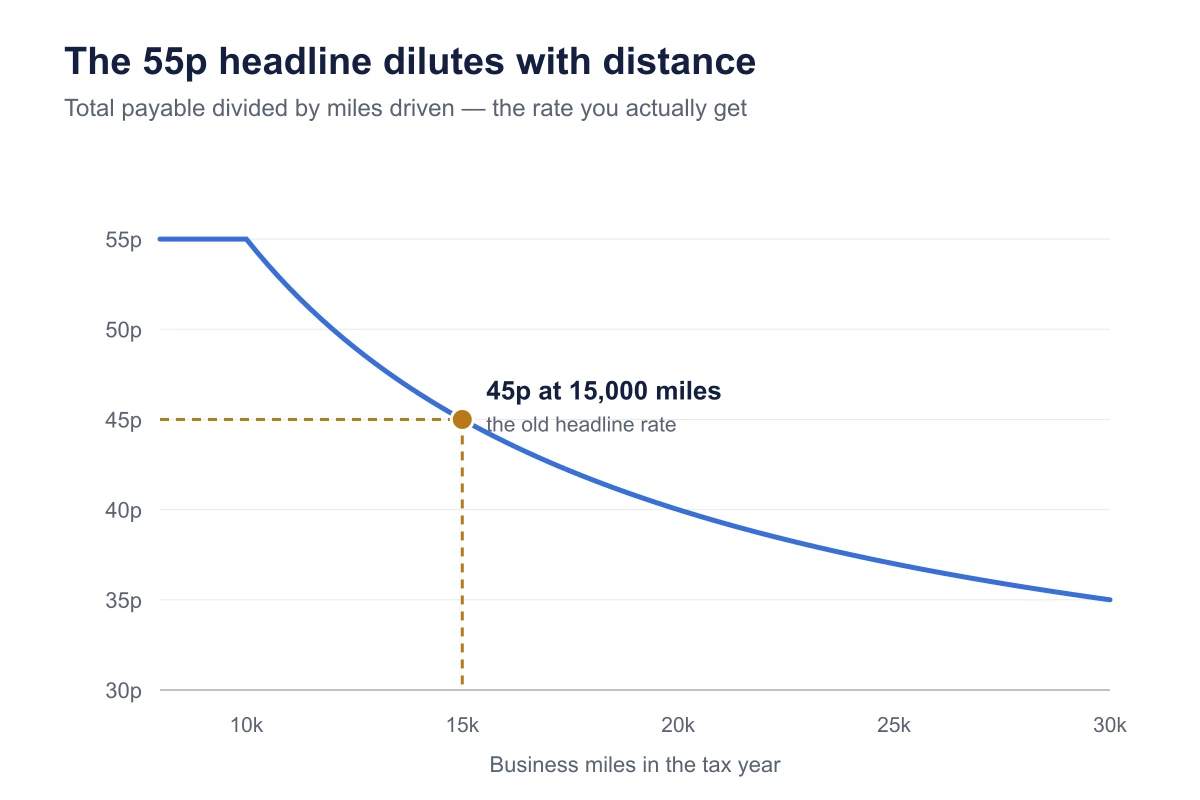
The headline rate describes the first ten thousand miles and nothing else, so the figure that actually matters to a high-mileage driver is the blended rate — the total divided by the miles.
| Business miles | Total payable | Blended rate per mile |
|---|---|---|
| 10,000 | £5,500 | 55.0p |
| 12,000 | £6,000 | 50.0p |
| 15,000 | £6,750 | 45.0p |
| 20,000 | £8,000 | 40.0p |
| 30,000 | £10,500 | 35.0p |
At exactly 15,000 business miles the blended rate is 45p — the number that was the headline until April. Drive further than that and the new, more generous scheme pays you less per mile than the old scheme's headline figure suggested, which is a strange thing to be true of a pay rise and is worth knowing before you agree a mileage policy built around “the HMRC rate”.
If you want to see what those miles cost you rather than what they pay you, our fuel cost calculator works the other direction, from pence per litre and miles per gallon.
If Your Employer Still Pays 45p, the Gap Is Yours
The approved rate is a ceiling on tax-free reimbursement, not an obligation. An employer may pay less, and a great many mileage policies name 45p for the simple reason that they were written when 45p was the number. Where you are paid below the approved amount, the shortfall attracts Mileage Allowance Relief, and the relief arrives at your own marginal rate.
| Business miles | Approved amount | Paid at old rates | Shortfall | Relief at 20% / 40% |
|---|---|---|---|---|
| 2,000 | £1,100 | £900 | £200 | £40 / £80 |
| 5,000 | £2,750 | £2,250 | £500 | £100 / £200 |
| 10,000 | £5,500 | £4,500 | £1,000 | £200 / £400 |
Relief is not the same as the shortfall itself, and the difference disappoints people who expect a cheque for £1,000. You are being given tax back on money you were never paid, so a basic-rate taxpayer recovers a fifth of the gap. That is still £200 for filling in a form once, on miles you have already driven.
Where an employer pays nothing at all, the whole approved amount is claimable: 10,000 miles produces a £5,500 claim and £1,100 of relief at the basic rate. If working out your own marginal rate is the uncertain part, the difference between marginal and effective rates is the thing to be clear on first.
Four Years Back, at the Rates That Applied Then
A claim can reach the current tax year and the four before it, which for most people is the largest number in this article. The trap is that the earlier years are claimed at their own rates: 45p for everything up to 2025/26, and 55p only from April 2026.
Take someone driving 8,000 business miles a year whose employer pays 25p a mile. For 2026/27 the approved amount is £4,400 against £2,000 paid, a shortfall of £2,400. For each of the four earlier years the approved amount was £3,600, a shortfall of £1,600. The five years together come to £8,800 of shortfall — £1,760 of relief at the basic rate and £3,520 at the higher rate.
That is a meaningful sum arriving from paperwork rather than from driving another mile, and the window closes one year at a time. The 2022/23 year drops out of reach at the end of this tax year and does not come back.
The Passenger Rule Works the Other Way Round
There is a second rate that almost nobody claims: 5p per passenger per mile, payable when you carry colleagues on a journey that is work travel for them too. Four people in a car for 200 miles is £30 on top of the mileage.
It behaves differently from everything above, and the asymmetry is worth stating plainly because it is genuinely counter-intuitive. With mileage, being underpaid gives you something to claim. With passenger payments it does not — HMRC's guidance says there is no relief if you receive less than 5p or nothing at all. An employer that declines to pay it has not created a claim; the money is simply gone.
So the passenger rate is one to raise with an employer rather than with HMRC, and it is the only part of this that you cannot fix afterwards.
What Counts, and What Quietly Does Not
Ordinary commuting never qualifies. Travel between your home and a permanent workplace is not business mileage however long it takes, and this excludes more journeys than people expect — including, for many, the longest drive of their week.
What does count is travel to a temporary workplace, and travel between workplaces in the course of a day. The distinction turns on whether the place is somewhere you attend for a limited duration or a specific task rather than as your regular base.
Keep the record as you go, journey by journey: date, where you went and why, and the distance. A single annual mileage total is the hardest kind of claim to defend, because it cannot be checked against anything. The record is also the part people cannot reconstruct four years later, which is why the backdated claim is so often smaller than it should have been.