
 Ashar Pervaiz
How Much Savings Before You Pay Tax on Interest
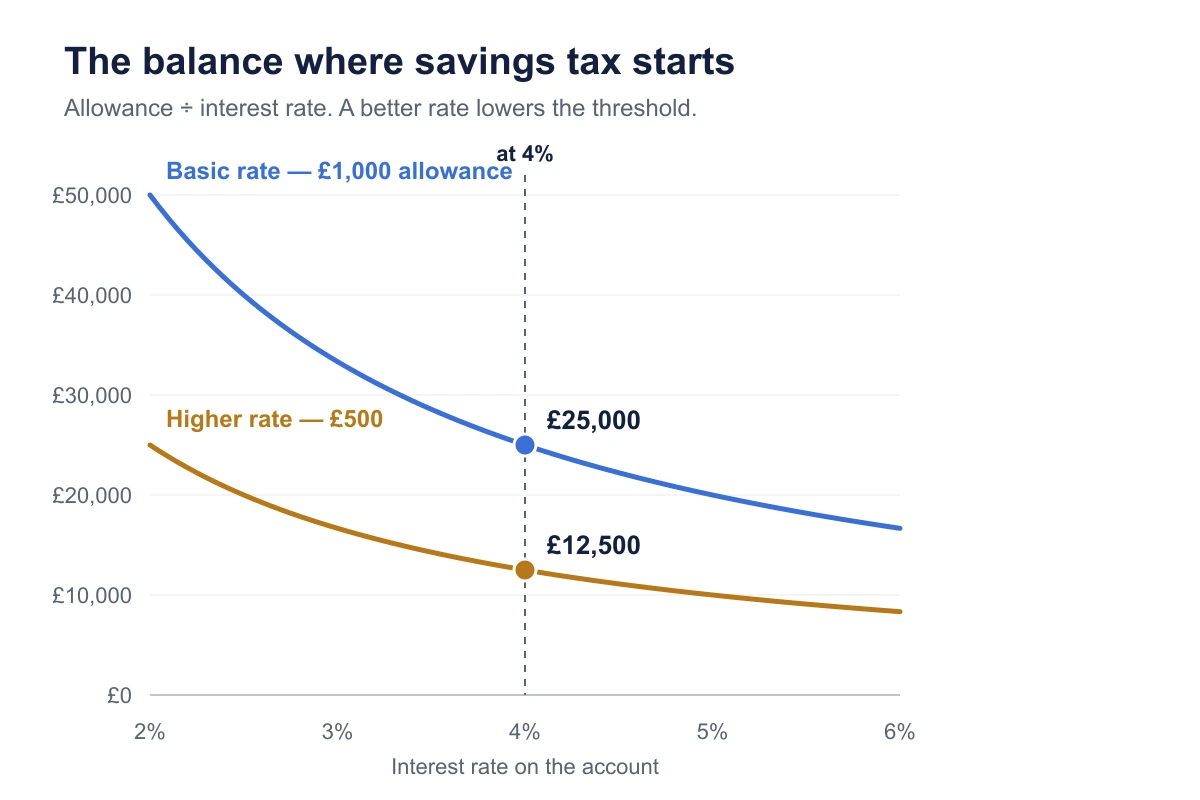
Divide your allowance by your interest rate. That is the whole answer, and for a basic-rate taxpayer with a £1,000 Personal Savings Allowance earning 4%, it comes to £25,000. Earn 5% and the threshold drops to £20,000; earn 3% and it rises to £33,333. A higher-rate taxpayer gets half the allowance and therefore crosses at half the balance — £12,500 at 4%. There is no cap on how much you may hold. The tax falls on the interest, so the balance that triggers it moves every time the rate does.
The Number You Want Is a Division
Almost every article on this subject answers a slightly different question from the one people ask. They explain the Personal Savings Allowance — £1,000 of interest tax-free for basic-rate taxpayers, £500 for higher-rate, nothing at all above £125,140 — and then stop, leaving the reader to do the step they actually came for. The allowance is denominated in interest. The balance in your account is not. Turning one into the other needs the rate.
Because the threshold depends on a rate that changes, the useful form of the answer is a table rather than a figure. Find the rate your account pays and read across.
| Interest rate | Basic rate (£1,000 allowance) | Higher rate (£500 allowance) |
|---|---|---|
| 2.0% | £50,000 | £25,000 |
| 3.0% | £33,333 | £16,667 |
| 3.5% | £28,571 | £14,286 |
| 4.0% | £25,000 | £12,500 |
| 4.5% | £22,222 | £11,111 |
| 5.0% | £20,000 | £10,000 |
| 6.0% | £16,667 | £8,333 |
Two things fall out of the table that are worth more than the numbers themselves. The first is that the threshold moves in the opposite direction to the rate, which feels wrong until you say it plainly: the better your account pays, the less you may hold before the tax starts. A rate rise is not purely good news for a saver near the line.
The second is the size of the gap between the two columns. The higher-rate threshold is not a little lower, it is exactly half, because the allowance halves. Moving from one band to the other does not gently increase the tax on your savings — it removes half the shelter in a single step, which is the subject of the third section below. If you want to run the division on the exact rate your own account pays, our percentage calculator will do it in one line.
There Are Three Allowances, Not One
The Personal Savings Allowance gets all the attention, and for someone in full-time work it is usually the only one that matters. But it is the last of three tax-free layers that interest can fall into, and people whose income comes mostly from savings rather than from a salary are routinely taxed as though the other two did not exist.
The first layer is the ordinary Personal Allowance of £12,570. If your other income does not use all of it, interest fills whatever is left. The second is the starting rate for savings, a £5,000 band charged at 0% that exists specifically for this situation. It is reduced by £1 for every £1 of non-savings income above the Personal Allowance, so it disappears entirely once other income reaches £17,570. The third is the Personal Savings Allowance itself.
Stacked, and with no other income at all, they let £18,570 of interest through untaxed. Here is how quickly that ceiling comes down as other income arrives.
| Other income | Unused Personal Allowance | Starting rate left | Interest you can receive tax-free |
|---|---|---|---|
| £0 | £12,570 | £5,000 | £18,570 |
| £5,000 | £7,570 | £5,000 | £13,570 |
| £10,000 | £2,570 | £5,000 | £8,570 |
| £12,570 | £0 | £5,000 | £6,000 |
| £14,570 | £0 | £3,000 | £4,000 |
| £16,570 | £0 | £1,000 | £2,000 |
| £17,570 or more | £0 | £0 | £1,000 |
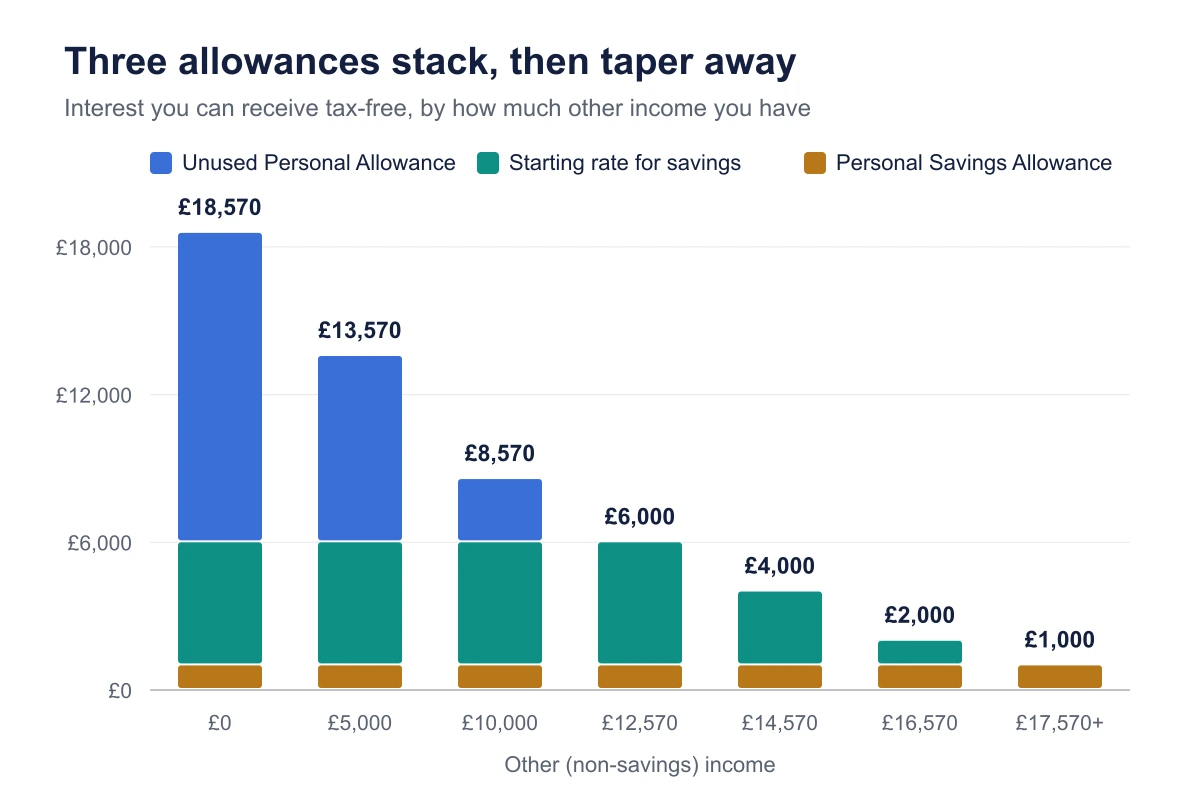
The middle rows are where the money is. Between £12,570 and £17,570 of other income, every extra pound earned costs a pound of starting rate — so a pensioner with a small private pension, a part-time worker, or someone living off savings between jobs can have several thousand pounds of interest a year entirely tax-free and never realise it. Read only the standard advice and you would put the ceiling at £1,000.
It also explains a result that looks like an error when you first meet it. Two people with identical savings and identical interest can face completely different tax bills purely because one of them has a modest wage, and the difference is far larger than the wage.
The Pound of Interest That Costs £100.40
The allowance does not taper. It steps. You have £1,000 of it while you are a basic-rate taxpayer and £500 the moment any part of your income reaches the higher rate — and interest counts towards deciding which of those you are.
That combination produces a genuine cliff edge at £50,270 of total income. Take a salary of £48,000. The basic-rate band has £2,270 of room left in it, so interest of exactly £2,270 keeps total income at £50,270 and the allowance at £1,000. One more pound takes you over, the allowance falls to £500, and £500 of interest that was tax-free a moment ago is taxed at 20%.
| Interest received | Total income | Allowance | Tax on the interest |
|---|---|---|---|
| £2,270 | £50,270 | £1,000 | £254.00 |
| £2,271 | £50,271 | £500 | £354.40 |
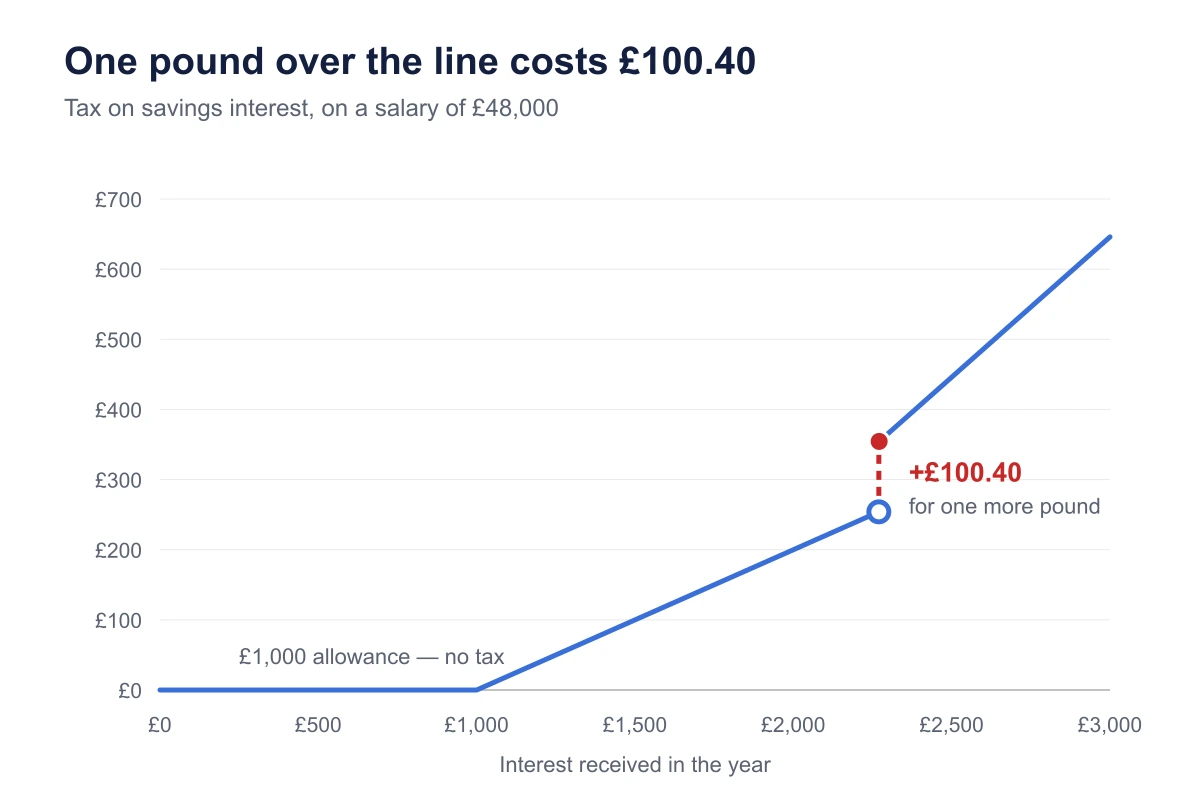
One extra pound of interest costs £100.40 in tax. The £100 is the lost half of the allowance being taxed at 20%; the 40p is the pound itself, now sitting in the higher-rate band. You are measurably worse off for having been paid more, which is the defining feature of a cliff edge rather than a tax band, and it is the same structure as the high income child benefit charge — a threshold where a trivial amount of extra income triggers a disproportionate loss.
£100.40 is the worst case, and it needs at least £500 of interest sitting above the allowance for the full effect. Below that the penalty is smaller but the shape is identical. What makes this cliff harder to avoid than most is that you cannot easily decline the income: interest is credited whether you want it that year or not. The lever is the balance, not the payment — which is precisely why the next change matters.
Worth separating from this: crossing the line does not increase the tax on your salary. The 40% rate applies only to the part above £50,270, and the jump described here is about the savings allowance alone. If that distinction is not second nature yet, marginal versus effective tax rates is the piece to read first.
In 2027 the Cash ISA Stops Absorbing the Overflow
For a decade the answer to all of this has been the same: put the savings in an ISA and the question disappears, because interest inside one is outside the tax system and does not touch any allowance. From 6 April 2027 that route narrows. The amount that can go into a cash ISA in a single year falls from £20,000 to £12,000 for savers under 65. The overall ISA allowance stays at £20,000 — the remaining £8,000 has to go into stocks and shares to stay sheltered. Savers aged 65 and over keep the full £20,000 in cash.
For anyone under 65 who has been filling a cash ISA each year and wants to stay in cash, that is £8,000 a year arriving in a taxable account instead. The effect is not a one-off. It accumulates, because each year adds another £8,000 on top of the last.
| After | Displaced from the cash ISA | Interest at 4% | Against a £1,000 allowance |
|---|---|---|---|
| Year 1 | £8,000 | £320 | Covered |
| Year 2 | £16,000 | £640 | Covered |
| Year 3 | £24,000 | £960 | Almost gone |
| Year 4 | £32,000 | £1,280 | Exceeded |
| Year 5 | £40,000 | £1,600 | Exceeded |
At 4%, the displaced money on its own uses up a full basic-rate allowance in the fourth year — and that is before counting a single pound of the savings you already hold outside an ISA. At 5% it takes three years; at 3%, five. The change lands in 2027, but the year it starts to cost you depends on the rate, and it arrives sooner than the headline suggests because the two pots add together.
The practical consequence is that the threshold table at the top of this article stops being background reading for a lot of people. A saver who has never once had to think about the Personal Savings Allowance, because everything sat in an ISA, may be inside the tax system within a few years of the change without having done anything differently.
How HMRC Finds Out, and How It Takes It
Nobody sends you a form to fill in. Banks and building societies report the interest they have paid to HMRC after the tax year ends, automatically, for every account you hold. The reporting happens whether or not any tax is due, which is why people who owe nothing sometimes still see their savings reflected in a coding notice.
If you are employed or receiving a pension, HMRC generally collects the tax by changing your tax code, so the money comes out of your salary in monthly slices rather than arriving as a demand. This has two consequences worth knowing. The first is that the code is built on an estimate — usually last year's interest — so in a year when rates have fallen you can be taxed through PAYE on interest you will never receive. That estimate is not binding, and a corrected figure given to HMRC changes the code rather than waiting a year for a refund.
The second is the £10,000 line. If savings and investment income together exceed £10,000 in a tax year, the tax code route is no longer available and a Self Assessment return is required — which catches people who have never filed one and do not think of themselves as having complicated finances. If a return is new to you, the mechanics of payments on account are the next thing to understand, because the first bill is rarely just the tax for the year.
Running It on Your Own Numbers
Three figures decide everything above: your interest rate, your balance, and your other income. The sequence takes a couple of minutes.
Start by multiplying the balance by the rate to get the interest, across every account you hold — the allowance applies to the total, not to each account, and splitting money between banks does nothing except make the total harder to see. Then work out which allowances you have: £1,000 if your total income including that interest stays under £50,270, £500 if it does not, plus any unused Personal Allowance and any starting rate if your other income is below £17,570. Subtract, and tax the remainder at your band.
The step most often skipped is the last check: add the interest to your other income and look at where the total lands. If it sits within a few hundred pounds above £50,270, you are on the wrong side of the cliff, and the amount at stake is larger than the amount that took you over. Our income tax calculator will place the total for you, and the net worth calculator is the quicker way to gather balances scattered across several accounts in the first place.
None of this is an argument for holding less. It is an argument for knowing which side of two specific lines you are on — £17,570 of other income, and £50,270 of total income — because both of them move more money than their size suggests.