
 Ashar Pervaiz
How to Convert Degrees to Radians
To convert degrees to radians, multiply by pi and divide by 180. So 90 degrees becomes 90 × π ÷ 180, which is π/2, or about 1.5708 radians. To go back the other way, multiply the radians by 180 and divide by pi. That is the whole thing. The rest of this page is why it works and where people trip up.
The Two Formulas
You only need these two lines.
radians = degrees × π ÷ 180
degrees = radians × 180 ÷ π
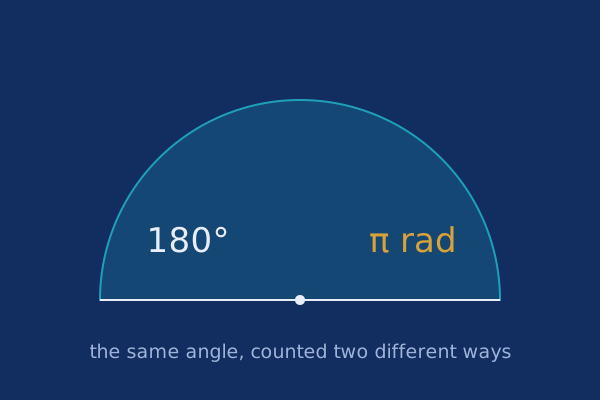
They are the same relationship read in opposite directions. If you can remember that 180 degrees and pi radians are the same angle, you can rebuild both formulas from scratch whenever you forget them.
Worked example, degrees to radians
Convert 60 degrees.
60 × π ÷ 180
= 60π ÷ 180
= π/3
≈ 1.0472 radians
The tidy way to do this by hand is to cancel before you reach for a calculator. Both 60 and 180 divide by 60, which leaves π/3 straight away. You only turn it into a decimal if something later in the question needs one.
Worked example, radians to degrees
Convert π/4.
(π/4) × 180 ÷ π
= 180 ÷ 4
= 45 degrees
Notice the pi cancels. That happens every time the angle is already written as a fraction of pi, which is why these conversions are usually easier in this direction than people expect.
The Angles Worth Knowing by Sight
These come up constantly in trigonometry. Most people end up remembering them rather than converting them every time.
| Degrees | Exact radians | Decimal |
|---|---|---|
| 1° | π/180 | 0.0175 |
| 30° | π/6 | 0.5236 |
| 45° | π/4 | 0.7854 |
| 60° | π/3 | 1.0472 |
| 90° | π/2 | 1.5708 |
| 120° | 2π/3 | 2.0944 |
| 135° | 3π/4 | 2.3562 |
| 150° | 5π/6 | 2.6180 |
| 180° | π | 3.1416 |
| 270° | 3π/2 | 4.7124 |
| 360° | 2π | 6.2832 |
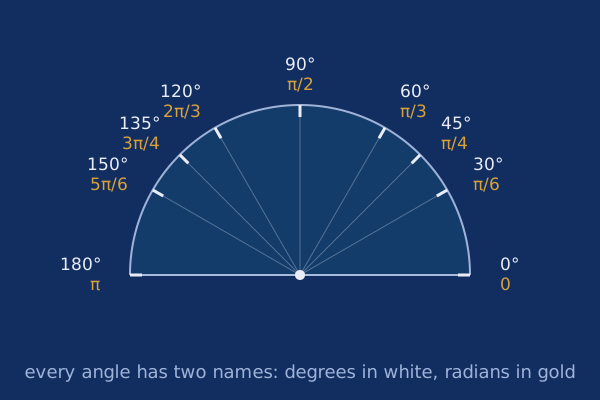
Every decimal in that last column is the exact value rounded to four places. If you need more of them, the math formula library has the trigonometric identities these angles feed into.
Where the 180 Comes From
This is the part that makes the formula stick, and it takes three lines.
A full turn around a circle is 360 degrees. The same full turn is 2π radians. Those are two names for one angle, so:
360° = 2π radians
180° = π radians
1° = π/180 radians
The second line is just the first one halved. The third is the second divided by 180. So one degree is π/180 radians, and if one degree is π/180, then any number of degrees is that number times π/180. The formula is not a rule somebody invented. It falls out of the fact that a circle can be measured two ways.
What a Radian Actually Is
Degrees got chosen as 360 for no deep reason. It just splits up nicely into other numbers, so it became the usual way to measure angles. The circle shape itself does not suggest that number at all.
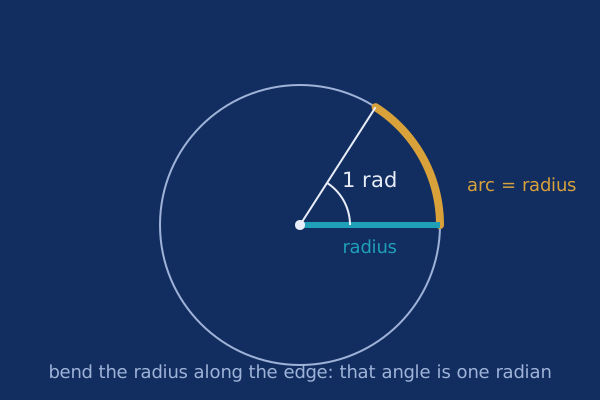
A radian comes from the circle directly. Take its radius and curve it along the edge. The angle covered is defined as one radian. That lands at about 57 degrees, since the full circle fits the radius a little over six times.
It feels easier to use degrees for most things. But the maths ends up nicer with radians. The derivative of sin x gives cos x right away only if the input is in radians. Degrees make you deal with that extra conversion factor each time, which complicates the work.
Angles Bigger Than a Full Turn, and Negative Ones
The formula does not care. It is multiplication, so it handles anything you give it, including angles that go round more than once and angles measured backwards.
| Degrees | Radians | What it means |
|---|---|---|
| -45° | -π/4 | a quarter of a right angle, clockwise |
| -90° | -π/2 | a right angle, clockwise |
| 450° | 5π/2 | one full turn plus a right angle |
| 540° | 3π | one and a half turns |
| 720° | 4π | two full turns |
A minus sign only tells you the direction you swept the angle in. By convention anticlockwise is positive, so -90° and 270° finish in the same place even though they are different journeys. That distinction matters when the angle describes a rotation, and not at all when it just describes a corner.
What GRAD Is Doing on Your Calculator
There is a third mode sitting next to DEG and RAD on most scientific calculators, and almost nobody is taught what it is. GRAD means gradians, sometimes called gons. A full circle is 400 of them.
The idea was to make a right angle a round 100 instead of 90, so that percentages of a quarter turn come out neatly. One gradian is 0.9 degrees. It never caught on in general use, but it hung on in surveying and in some European civil engineering, which is why calculators still carry it.
radians = gradians × π ÷ 200
100 grad = π/2 = 1.5708 radians = 90°
For most people the only thing worth knowing is that this mode exists, because nudging the button by accident is a common way to get trigonometry answers that are wrong in a way you cannot explain.
Where You Actually Meet Radians
Outside a maths classroom, radians turn up wherever something spins or curves.
Angular velocity is measured in radians per second. A record playing at 33.3 rpm is turning at about 3.49 rad/s, because one revolution is 2π radians and there are 60 seconds in a minute. Engineers use rad/s rather than rpm because it drops straight into the equations for torque and kinetic energy without a conversion step.
Arc length becomes trivial. The distance along the curve is simply the radius multiplied by the angle in radians. No π/180, no correction factor. That one line is most of the reason radians exist.
Graphics and game code rotate everything in radians. If a sprite spins four times faster than it should, or a camera jerks to a strange angle, a degree value has usually been passed where a radian was expected.
The Mistake That Costs Programmers an Afternoon
Almost every programming language assumes radians. Python, JavaScript, Java, C and most spreadsheet functions all do. So this looks right and is not:
Math.sin(90) → 0.894
math.sin(90) → 0.894
The sine of 90 degrees is 1. What the code calculated was the sine of 90 radians, which is about fourteen and a third full turns around the circle, landing somewhere unrelated. The fix is to convert before you call the function:
Math.sin(90 * Math.PI / 180) → 1
math.sin(math.radians(90)) → 1
The reason this bug survives so long is that it never crashes. You get a number back, it sits between -1 and 1 like a sine should, and nothing looks wrong until the output is plotted. If an angle calculation is giving plausible but wrong answers, this is the first thing to check.
Spreadsheets behave the same way. In Excel and Google Sheets, SIN(90) assumes radians, and there is a RADIANS() function for exactly this reason.
Three Things People Get Wrong
Multiplying by π/180 in the wrong direction. If the answer comes out bigger than the number you started with, going from degrees to radians, something has gone backwards. A radian is a much larger unit than a degree, so the radian figure is always the smaller number. 90 becomes 1.5708, not 5157.
Rounding pi too early. Using 3.14 instead of the full value is fine for a rough check and not fine for anything that gets built or marked. Keep the answer as a fraction of pi for as long as you can and let the calculator handle the decimal at the very end.
Assuming a calculator is in the mode you think it is. Most scientific calculators have DEG, RAD and GRAD modes, and they do not announce themselves loudly. If your trigonometry answers are wrong by a consistent and strange amount, check the mode indicator before you check your working.
For conversions that are not angles, the unit conversion calculator covers length, weight, temperature and the rest, and the quadratic equation calculator shows its working the same way the examples above do.